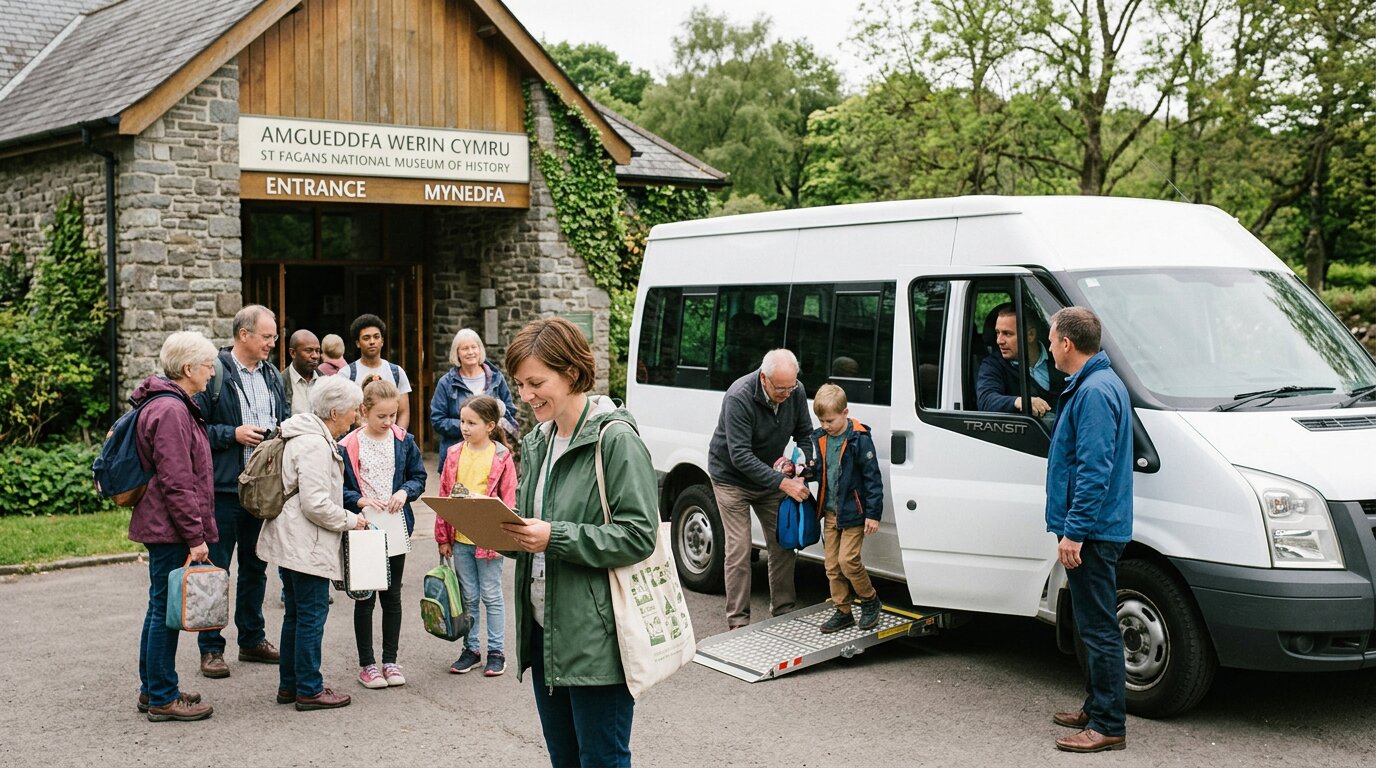
Museum visits in Wales are among the easiest group trips to justify. Many of the national museums are free, the collections suit every age, and a day out can be built around a single site. The transport is what takes the organising. This worksheet approach starts from the museum and works backwards to the vehicle, so the minibus is booked for the visit you actually have, not the other way round. The examples below are Welsh, but the method suits anyone organising a group visit to a museum, gallery or heritage site, because the questions change little from one collection to the next.
Step 1: Pin down the museum’s group rules
Before choosing transport, contact the museum. Group arrangements differ from site to site, and the details affect your timings. At St Fagans National Museum of History near Cardiff, for example, all groups must pre-book, admission is free during normal opening times, and pre-booked groups get small extras such as refreshments for the coach driver. The museum’s visitor page lists a daily parking charge for cars, so ask how a minibus will be treated when you book.
Libraries and archives can have their own rules. The National Library of Wales in Aberystwyth says coats and bags can’t go into its Reading Room and must be left in lockers that take a £1 coin. Small detail, but it changes what you tell a group to bring.
Step 2: Gather the group’s requirements
Collect this before you speak to any hirer: final head count including leaders, ages, any wheelchair users or people who need step-free access, and what everyone is carrying, such as packed lunches, sketchbooks, or overnight bags if the trip is longer than a day. School and youth groups should also check their organisation’s own trips policy. The Royal Geographical Society’s transport safety guidance for school fieldwork advises following your employer’s transport guidance, since many employers have specific policies on minibuses and supervision.
Step 3: Answer the booking questions
Who in our group can legally drive a minibus?
Check this first, because it can rule out self-drive hire altogether. GOV.UK’s minibus page explains that a car licence may cover a minibus with up to 16 passenger seats only when there is no payment from or on behalf of passengers and every other condition is met: the driver is 21 or over, has held a licence for two years and is driving voluntarily, the minibus is used for social purposes by a non-commercial body, no trailer is towed, and the minibus has a maximum authorised mass of no more than 3,500kg (4,250kg for electric or hydrogen vehicles). Drivers over 70 must also meet the Group 2 medical standards. If passengers contribute to running costs, the same page explains when a minibus permit is needed for the trip; a permit doesn’t remove the need to check each driver’s own entitlement. Where the car-licence conditions aren’t met, the driver will normally need full minibus (D1) entitlement. Ask the hirer for the maximum authorised mass of the exact vehicle, as that alone can settle the question.
We’re starting from the Cardiff area. Where can we ask about minibuses?
A group planning a St Fagans or city-centre museum day could check minibus availability in Cardiff; the site lists vehicles from seven-seaters to 17-seat minibuses and sets out its own driver age and licence requirements. Check those against the GOV.UK conditions above and ask for them in writing for the exact vehicle, alongside insurance cover, deposit and collection or delivery arrangements.
Our group is based in mid Wales. Is there anything nearer Aberystwyth?
For a group starting near Cardigan Bay, perhaps visiting the National Library or heading inland to another collection, the minibus hire information for Aberystwyth is another starting point. Put the same licence, insurance and seating questions to the hirer, and check how much luggage space remains with every seat in use.
How long should the day be?
Longer than you think. Build in arrival, toilets, lunch and the gift shop as well as the galleries. On longer drives, the Highway Code’s recommendation of a 15-minute break after every two hours of driving is a sensible minimum, and a second qualified driver takes the pressure off the return.
The group-trip worksheet
Fill this in for each trip. Anything left blank is something still to confirm.
| Section | Question | Answer / confirmed by |
|---|---|---|
| Booking | Museum and date booked? Group reference? | |
| Booking | Deadline for final numbers? | |
| Access | Minibus drop-off and parking point; any charge? | |
| Access | Step-free route from drop-off to entrance confirmed? | |
| Seating | Passengers including leaders; vehicle seats required | |
| Seating | Wheelchair or mobility needs and how they’ll be met | |
| Luggage | What’s being carried; space with all seats filled; lockers at the museum? | |
| Drivers | Named drivers; licence checked against GOV.UK and hirer rules | |
| Drivers | Second driver for return? Break points planned? | |
| Safeguarding | Leader ratio, emergency contacts, organisation policy followed | |
| Return | Departure time, meeting point, final head count |
Step 4: Confirm responsibilities in writing
The last step is the one most often skipped. Write down who is responsible for what: the museum booking, the vehicle, the drivers, first aid and the head count. Send it to the leaders a week before. On the day, the worksheet becomes the checklist, and anyone can pick it up if the organiser is busy with a lost lunchbox.

